ddma: data-driven models and abstractions
Learn a guaranteed model of an unknown system from data, then build controllers that are provably safe for the real system.
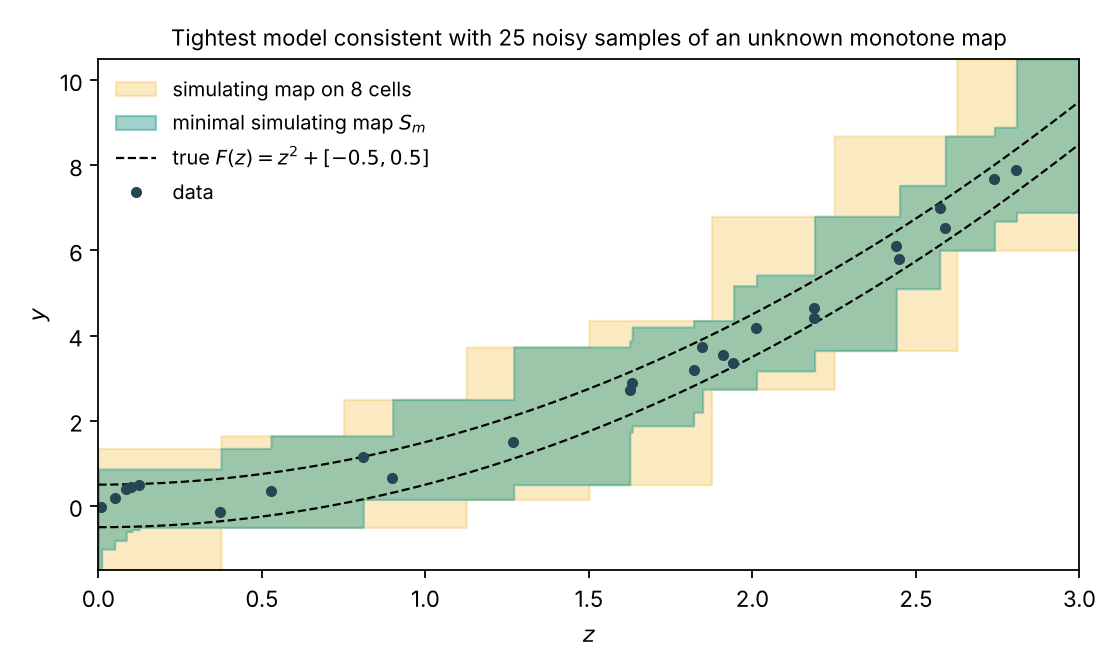
ddma takes measured transitions of a system whose dynamics are partly unknown and returns a set-valued model that is guaranteed to contain the true dynamics. It needs no model class: only a structural assumption (the unknown part is monotone, or its derivatives are bounded) and a bound on the disturbance. From that model it builds a finite abstraction and synthesizes controllers (safety, reach-avoid) whose guarantees carry over to the real system. It can also compute safe operating envelopes directly from the data, without a grid.
The pipeline in four steps
Transitions \((x_k, u_k, x_k^+)\) of the real system: logged, simulated or measured online.
The tightest set-valued model consistent with the data and the assumptions.
A finite system on a grid of cells that over-approximates every possible behaviour.
The maximal safe set and the inputs that keep you in it: a controller, or a safety filter around any other one.
Where to start
New to ddma: read Core ideas, then work through the tutorials in order. Each one builds on the previous one.
Working in MATLAB: every function has a MATLAB counterpart, see Python ↔ MATLAB. The tutorials show the MATLAB calls next to the Python ones.
Looking for a function: API reference.
Install
pip install ddma
MATLAB (R2023b or newer): download ddma-<version>.mltbx from the
releases page and open it in MATLAB.
Details, including Octave, installing from a clone and supported systems: Installation.