← Projects · Industry
Real-time MPC: a car, a quadrotor and a robot arm
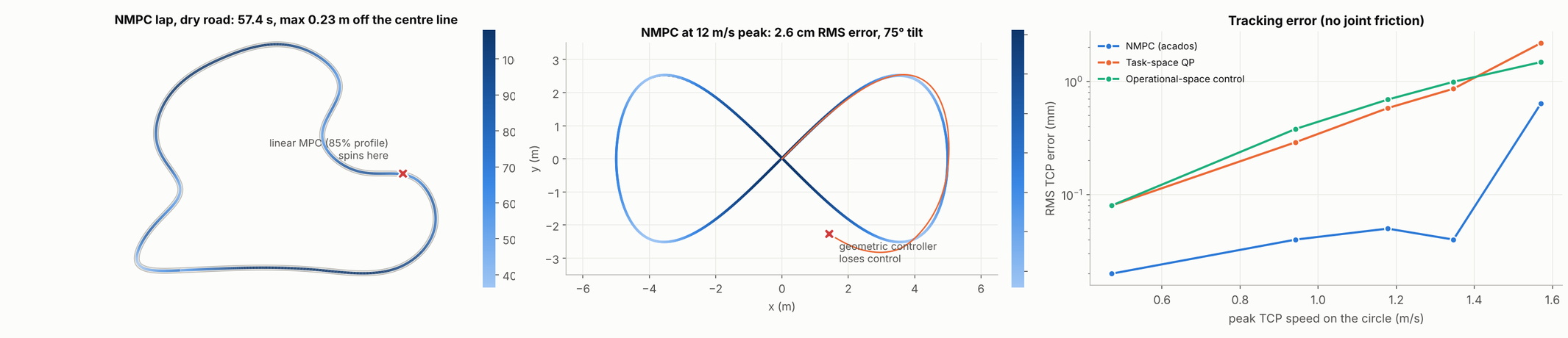
Nonlinear model predictive control that runs in milliseconds, on three platforms: a car at the handling limit, a quadrotor in aggressive flight and a 7-joint robot arm. Each controller beats the one used in practice, is timed step by step and runs as a C++ ROS 2 node. On each, a limit learned from data with ddma (tyre grip, rotor thrust, joint friction) keeps the plan within what the hardware can give.
NoteHow much grip can a controller count on? →
0.4–3.5 msmedian solve per control step, on the full nonlinear model
3 platformsa car, a quadrotor and a 7-joint arm, each against the controller used in practice
0spins or crashes when the hardware degrades, planning with limits certified from seconds of data
10⁻⁶agreement between each C++ ROS 2 controller and its Python version
The three projects
Each panel shows what ddma certified for that platform from a few seconds of data.
 Car at the handling limit
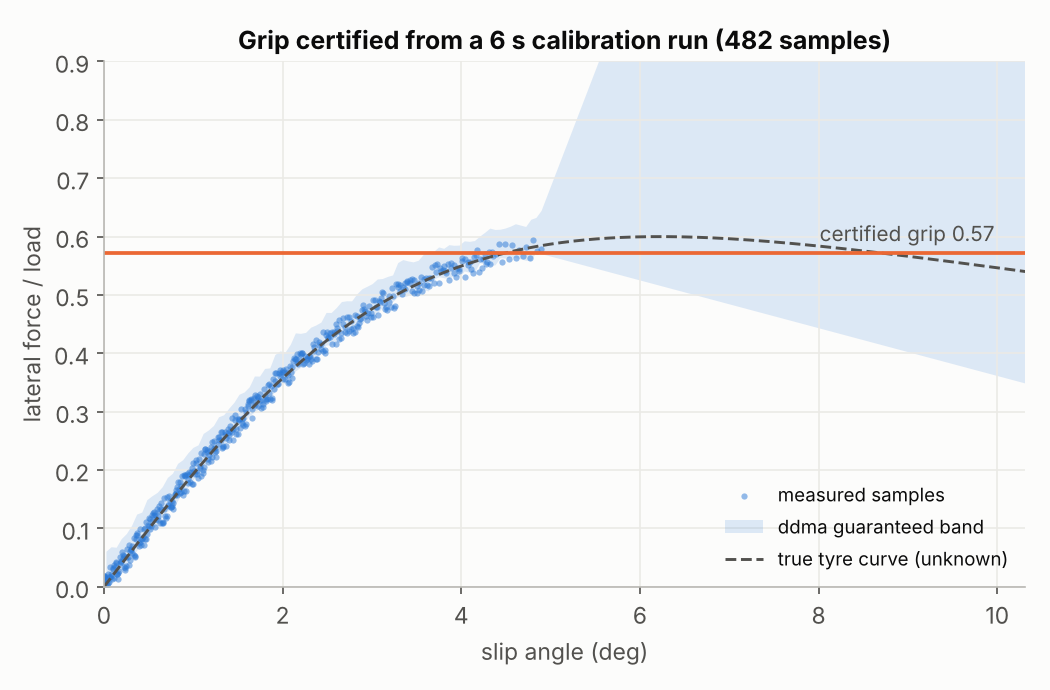
Drives close to the tyres' limit where linear MPC spins; on a slippery road it plans with a grip level certified from six seconds of driving.
≈ 1 ms solve · 9 % faster lap · 0 spins on a slippery road
Open the car project →
 Quadrotor in aggressive flight
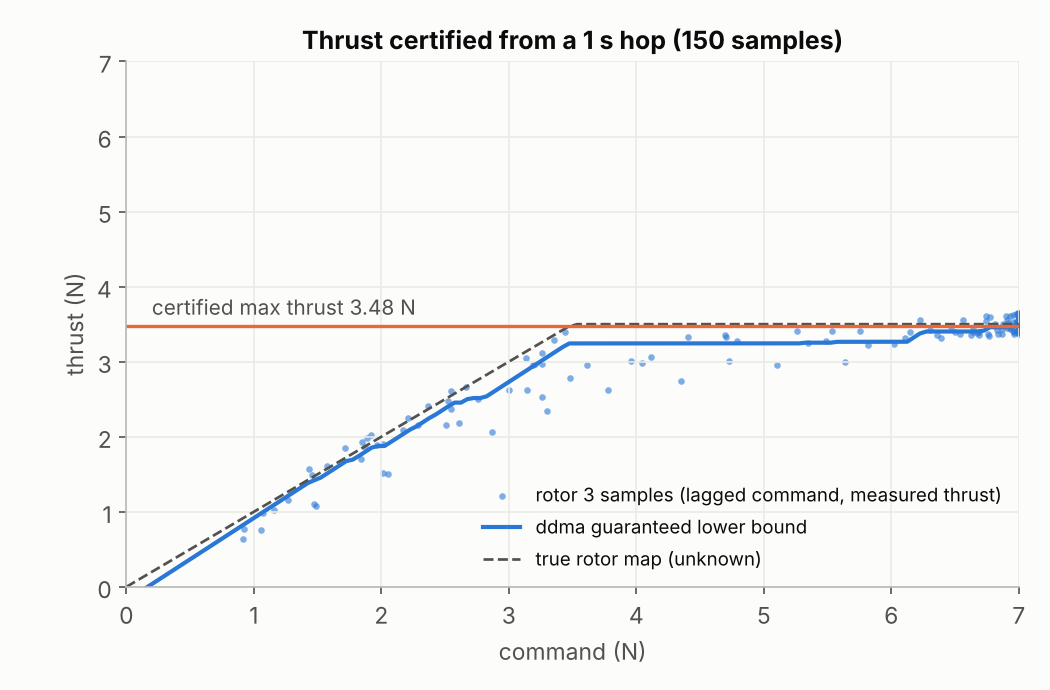
Commands the four rotor thrusts directly through a figure-8 at up to 12 m/s; with a damaged propeller it flies on thrust limits certified from one second of data.
≈ 0.4 ms solve · 2.6 cm at 12 m/s · flies with a damaged rotor
Open the quadrotor project →
 7-joint robot arm
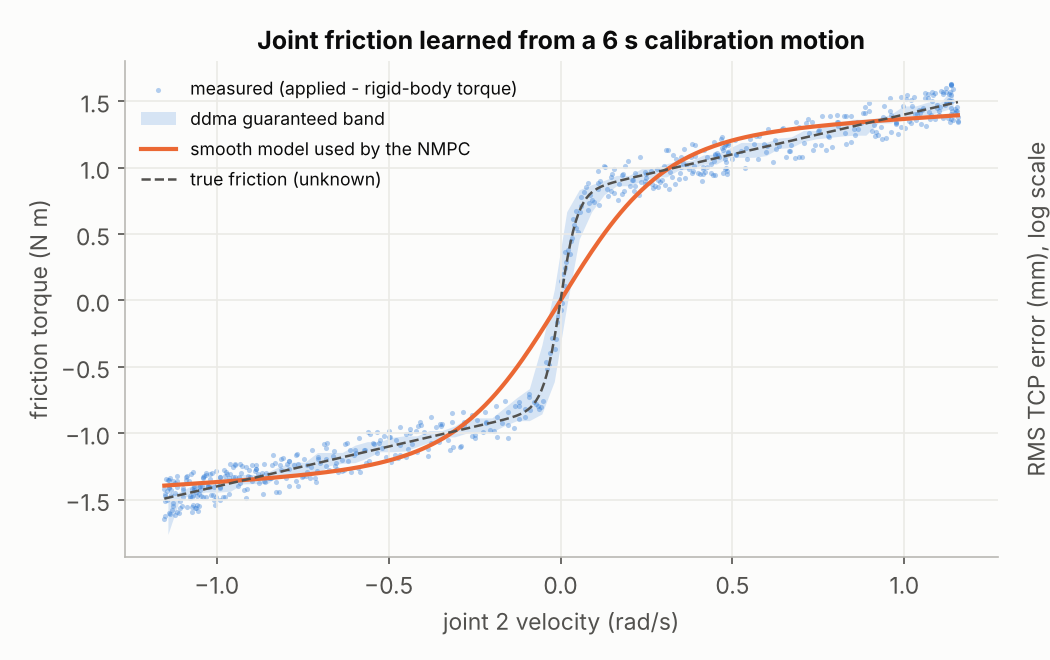
Commands a Franka Emika Panda's joint torques around a fast circle within every joint's limits, with a friction model learned with a certified bound.
≈ 3.5 ms solve · 0.04 mm at 1.35 m/s · 1 kHz torque loop
Open the arm project →
Side by side
| Car | Quadrotor | Robot arm | |
|---|---|---|---|
| Model | Dynamic bicycle, magic-formula tyres, friction circle per axle | Rigid body with quaternions, four rotor thrusts, rotor drag | Full Panda dynamics, 14 states, 7 torques |
| Plan / rate | 2 s ahead, 50 Hz | 1 s ahead, 100 Hz | 0.35 s ahead, 100 Hz |
| Median solve | ≈ 1 ms | ≈ 0.4 ms | ≈ 3.5 ms |
| Against the usual controller | Linear MPC spins on the same speed profile; the slowest profile it finishes is 9 % slower | Geometric (SE(3)) controller: 2.4× the error at 10 m/s, crashes at 12 m/s | Operational-space control: 25× the error at 1.35 m/s, joints at 135 % of their velocity limit |
| ddma certifies | Tyre grip, from a 6 s steering ramp: 0.57 for a true 0.6 | Rotor thrust, from a 1 s hop: 3.48 N for a true 3.5 N | Joint friction, from a 6 s sweep: within 0.3–0.7 N m |
| With the certificate | Finishes the slippery lap, 2 % slower than knowing the road | Flies both laps with a damaged rotor | 0.05 mm with joint friction, as good as knowing it |
| Code | vehicle-nmpc | quadrotor-nmpc | arm-nmpc |
The common recipe
- ModelThe platform's nonlinear model in CasADi, with the limits that matter on the real machine: grip, rotor thrust, joint torques and speeds.
- Optimise in real timeacados, multiple shooting, one SQP iteration per control step, warm-started from the last plan; checked against a solve to convergence.
- Certify the hardwareddma turns seconds of measured data into a limit that is guaranteed to hold; the plan never asks for more. Set at run time, without rebuilding the solver.
- DeployGenerated C code inside a ROS 2 Jazzy C++ node, next to a simulator node running the machine at 1 kHz.
Engineering, shared by all three
- Fair baselines: each controller is compared with the design used in practice, with the same limits, and timed step by step (median and 99th percentile, not only the average).
- C++ that matches Python: the C++ simulators reproduce the Python ones to 10⁻⁹ and the C++ controllers reproduce the Python commands to 10⁻⁶.
- Launch tests: each ROS 2 package runs the closed loop and checks tracking, limits, solver status and latency.
- CI (GitHub Actions): lint, Python tests with acados built from a pinned commit, the ddma certificate tests, and the ROS 2 build and tests in a ROS container; a Docker image per repository.
Next
Hardware runs (an F1TENTH-scale car, PX4 hardware-in-the-loop, a Panda through franka_ros2), and certificates that update during operation: grip while driving, rotor thrust mid-flight.